
Harmony ball necklace: what it is and why it has so many names
A harmony ball is a small hollow pendant with a bell inside, worn in pregnancy. It is sold under half a dozen names, which makes shopping for one harder than it needs to be.
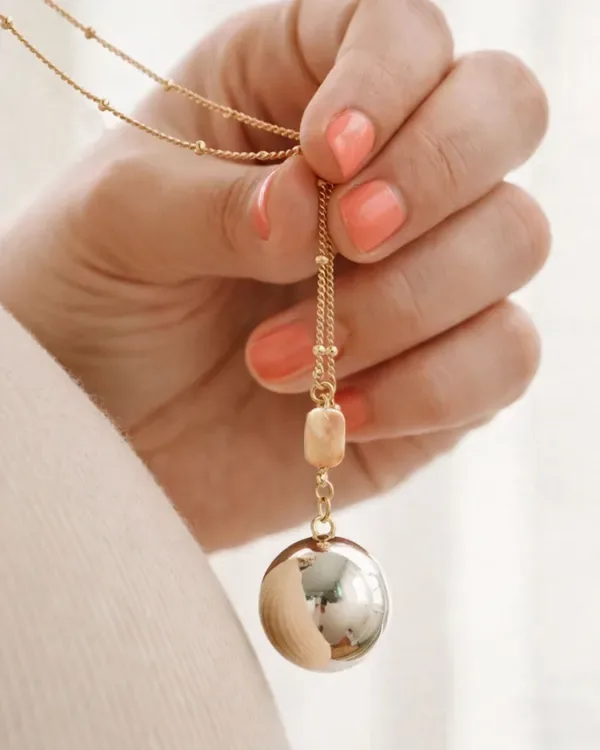
Short answer: A harmony ball is a hollow pendant with a small bell inside that chimes softly as you move. Bola, angel caller, chime ball and pregnancy bell are other names for the same necklace.
How a harmony ball works
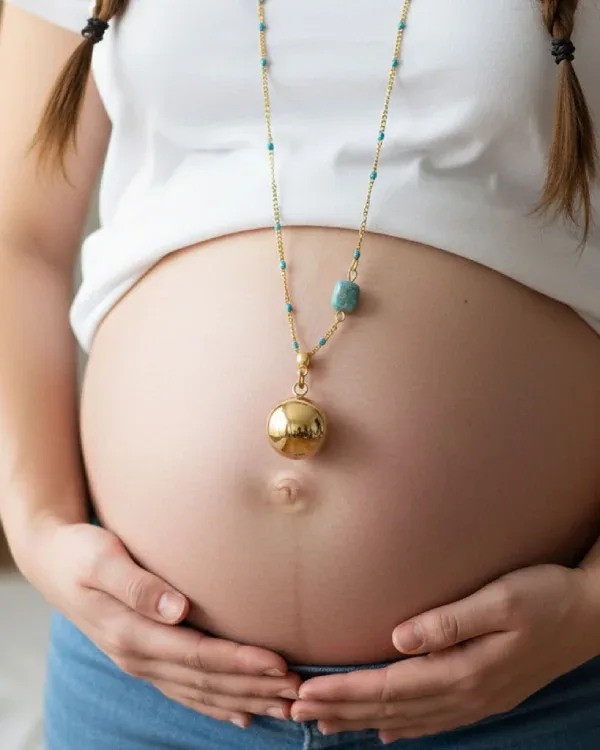
A harmony ball is a hollow metal ball with a small bell or bead inside. When you move, the bell touches the walls of the ball and makes a light, steady chime. You wear it on a long chain, so it hangs over the bump rather than at the collarbone.
Two shapes are common. A smooth ball is a plain sphere, polished or brushed. A cage is an openwork pendant, often with a pattern, that holds the ball inside. Cages let more sound out and look more ornate. Smooth balls look cleaner and are easier to wipe clean.
Other names for the same necklace
Shopping for one is confusing because sellers use different names for the same jewellery. These all describe a chiming pendant worn in pregnancy:
| Name | Where you will see it |
|---|---|
| Harmony ball | The most common name in UK shops. |
| Bola | Short for the Spanish and French names. “Bola necklace” and “pregnancy bola” mean the same thing. |
| Angel caller | A translation of the Mexican name llamador de ángeles. |
| Chime ball, bell necklace | Descriptive names. They put the sound first. |
| Mexican bola | Used for pieces sold with the Mexican origin story. |
Whatever the label, check the same things before you buy: the metal, the size, the chain length and the sound. We list them in the pregnancy necklace buyer’s guide.
Where it comes from
Nobody can point to a firm historical record, so treat the origin as folklore. Two stories are told most often.
- Bali and Indonesia. Silver work and protective bells have a long tradition there, and pendants like this are still made on the island.
- Mexico. The necklace is known as llamador de ángeles, which is where the English name “angel caller” comes from.
In Europe the necklace spread through word of mouth and shops, and it is now a familiar pregnancy gift.
What it is said to mean
The idea behind the name is that the chime calls guardian angels to watch over the baby. You do not need to believe that to enjoy the jewellery. Most women who wear one describe something simpler: a small sound that reminds them of the baby during the day, and a keepsake of a particular time.
Tradition, not science
We treat the meanings as symbolism and family tradition. A harmony ball is jewellery. It is not a medical product and we make no claim about its effect on you or your baby.
Does the baby hear it?
Babies start to react to sound in the second half of pregnancy. You will often read that the chime soothes them, but there is no good evidence for that, so we won’t say it. It is kinder to the jewellery to describe it honestly: it makes a pretty sound that you can hear, and it is a keepsake.
Who wears one, and when
Most are worn from around the fifth month, either bought by the mum herself or given by a partner, a sister or a friend. They are a popular baby shower present and a common gift to announce a pregnancy. After the birth many women keep wearing theirs, or put it away for the baby to have later. For a second baby, you can simply wear the same one again. More in what to do after the birth.
Questions people ask
What is the difference between a harmony ball and a bola?
Nothing, in practice. Both names describe a hollow pendant with a bell inside, worn in pregnancy. “Bola” comes from Spanish and French. “Harmony ball” is the more common English shop name.
Is a harmony ball the same as an angel caller?
Yes. “Angel caller” translates the Mexican name llamador de ángeles. It is the same necklace.
Are harmony balls only for pregnancy?
Mostly, but not only. Some people wear one to keep a baby, a child or a person they love close, and many women keep wearing theirs after the birth.
Can I wear a harmony ball when I am not pregnant?
Yes. Nothing about the jewellery is specific to pregnancy beyond the long chain and the tradition.
Keep reading
Pregnancy necklace buyer’s guide
Metal, size, sound and chain length, explained.
When to start wearing one
The traditional fifth month, and why you can ignore it.
Is a harmony ball safe?
What to check, and how to wear one around a baby.
Made to order in France
Shop on Etsy (opens Etsy in a new tab)